BRINGING THINGS INTO FOCUS
Application scope to be evaluated
In-flow vision.
Inspection of moving parts
For inspection tasks on moving parts. Define motion, spacing, trigger timing and the required result before choosing imaging and illumination.
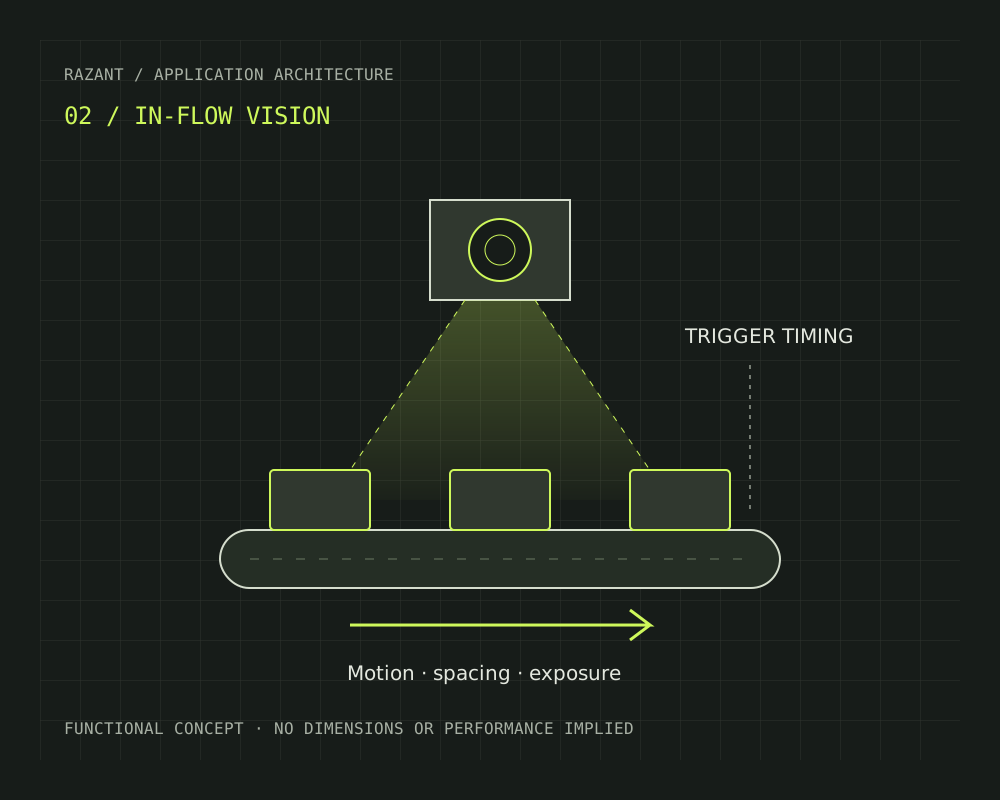 FUNCTIONAL CONCEPT / NOT A PRODUCT RENDER
Moving-part acquisition
RGB and native monochrome variants planned
Timing assessed with the machine
+DESIGNED AROUND THE INSPECTION
Motion is part of the specification.
Record part velocity, spacing, orientation and the available trigger signal. Exposure and lighting must preserve the detail needed for the inspection; pixel count alone cannot establish the result.
Give the machine a useful answer.
Agree the acceptance rule, output format and the time available for the next machine action. Evaluate representative parts and failure cases before committing to a performance envelope.
MODULAR VISION / INTENDED ARCHITECTURE
01 / ACQUIRE
Modular sensor
Optics + image sensor PCB
02 / PROCESS
Embedded compute
Onboard processing intended
03 / CONNECT
Industrial interface
24 V DC + Ethernet intended
04 / CONFIGURE
RAZANT Studio
Local browser configuration
CONTROL + LIGHTING INTERFACES TO BE SPECIFIED
Configuration scope. Component selection, electrical design, thermal limits, and compliance requirements are specified for the selected application.
+CONFIGURE FOR THE APPLICATION
A clear view
of the details.
These specifications describe the intended direction. They are not a released product datasheet. Dimensions, performance, environmental limits, and compliance remain subject to engineering validation.
| Acquisition role | Parts moving through the inspection area |
|---|---|
| Imaging direction | Separate RGB and native monochrome sensor variants |
| Core architecture | Onboard processing, 24 V DC input and Ethernet are intended |
| Optics | Interchangeable optics; field of view set around the part |
| Timing | Motion, exposure, triggering and result latency require application testing |
| Illumination | Coordinate the exposure and strobe requirements with the material |
| Open boundaries | No validated speed, throughput, read rate or environmental rating |
+POSSIBLE APPLICATIONS
Define the motion. Time the image.
+Practical questions
A little more clarity.
How fast can the part move?
No validated motion or throughput limit is published. The smallest feature, exposure, light, trigger timing and processing workload must be evaluated together.
Can directional frames be combined on moving parts?
Sequential frames capture different moments. Movement can misalign them; synchronization and registration must be assessed. The simulated relief example is not a measured moving-line result.
Does the system replace stationary inspection?
These are different acquisition roles. Choose the role from the process and acceptance rule; a legacy camera model does not establish the configuration of either current family.
+YOUR CONFIGURATION
Make it your starting point.
YOUR STARTING POINT
In-flow vision.
- Optics
- Evaluate with my samples
- Lighting
- Recommend for my application
- I/O
- Discuss integration requirements
- Accessories
- None selected
Application requirements, not a validated bill of materials. Compatibility and a complete price will be assessed together. No total is estimated for this configuration.
Request a scoped quotation* Compare complete application scope: optics, lighting, power, mounting, software, integration, support and any recurring costs. No family price is approved.
+OPEN FOR APPLICATION EVALUATION
Have a job for In-flow vision?
Bring a sample, a constraint, or a question. Let’s find out how the system fits your application.
Discuss your application