BRINGING THINGS INTO FOCUS
+UNDER THE ENCLOSURE
Good engineering.
Less ceremony.
A common embedded platform. Modular optics and illumination. Local software. The intent is to make the system coherent, from the connector to the configuration screen.
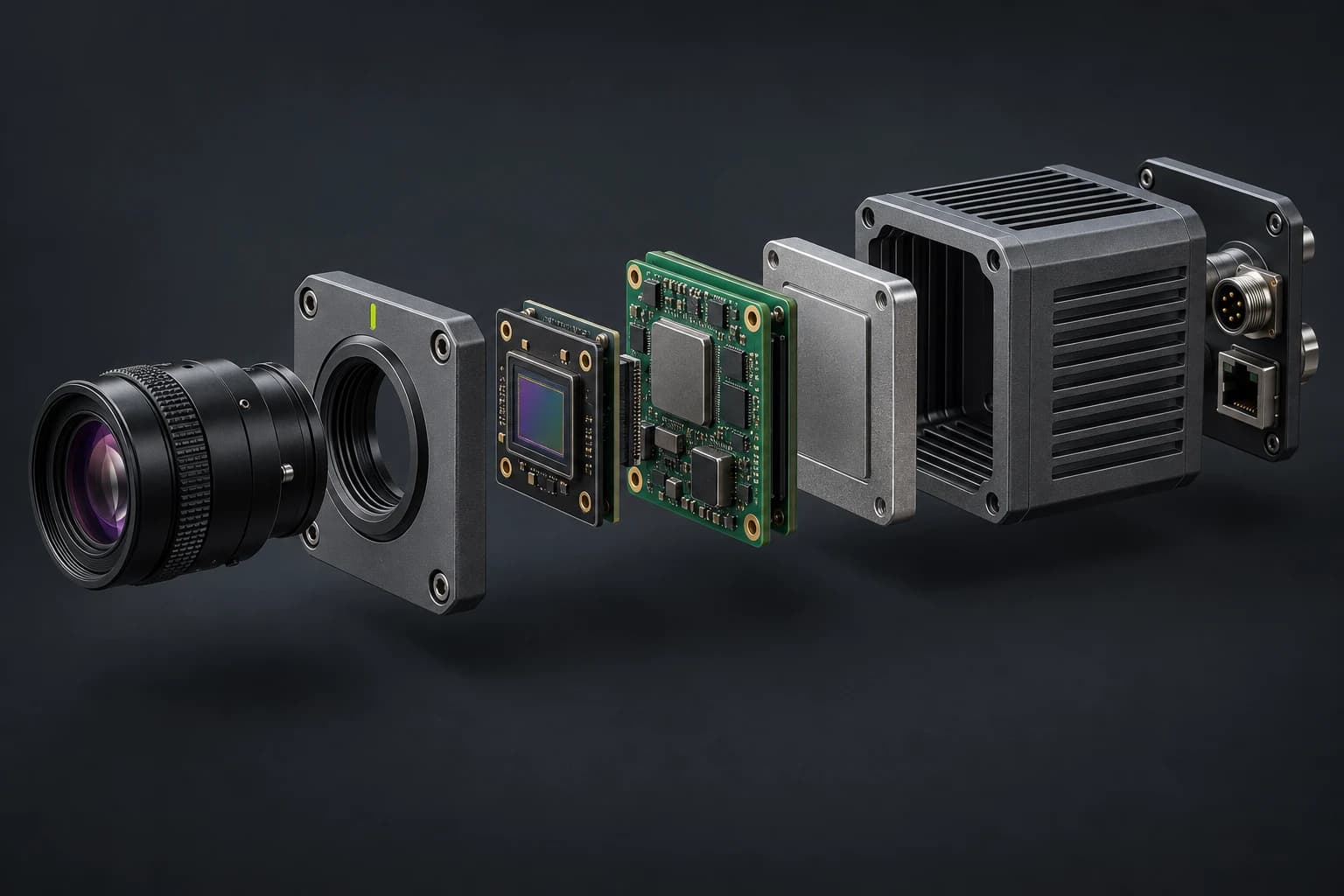 ILLUSTRATIVE CONCEPT / NOT MEASURED HARDWARE
+01 / RAZANT
A platform, not an island.
Select imaging, compute, illumination and integration as a complete system around the inspection.
MODULAR VISION / INTENDED ARCHITECTURE
01 / ACQUIRE
Modular sensor
Optics + image sensor PCB
02 / PROCESS
Embedded compute
Onboard processing intended
03 / CONNECT
Industrial interface
24 V DC + Ethernet intended
04 / CONFIGURE
RAZANT Studio
Local browser configuration
CONTROL + LIGHTING INTERFACES TO BE SPECIFIED
Configuration scope. Component selection, electrical design, thermal limits, and compliance requirements are specified for the selected application.
Compute with a defined job.
Match embedded Linux compute to acquisition, inspection recipes and result handling. Processing cost should follow the workload, not a specification-sheet contest.
A carrier designed for the machine.
Connect imaging, compute, power and I/O with the simplest suitable modules. Custom electronics should earn their cost through a clear integration or performance need.
Industrial connections, deliberately.
Specify machine power, Ethernet messages and protected I/O around the installation. Trigger timing and control behavior belong in the integration contract.
Light is part of the system.
Coordinate directional illumination with image acquisition. Select drive, exposure, sequence and duty cycle for the material and cycle time.
A thermal path, not just a shell.
Enclosure, cooling and mounting work together. Establish the ambient conditions and environmental requirements before selecting the configuration.
Local configuration. Shared tools.
Keep camera setup, recipes and results in a common browser workspace. Specify network access, update procedures and system interfaces with the deployment.
+02 / RAZANT
Four directions. More evidence.
A simulation of complementary lighting shows how direction can reveal surface relief behind difficult markings.
RELIEF IMAGING / SIMULATIONSIMULATED IMAGERY
SAMPLE 01 / DEBOSSED CARDBOARDLEFT CHANNEL
TAKE A DIFFERENT VIEWThe detail is
The detail is
already there.
A directional light makes one edge brighter and the opposite edge darker. Try another direction to see the relief change.
Synthetic surface and lighting. Not captured by RAZANT hardware. Real performance depends on material, geometry, motion, and sample validation.
Compare opposing views.
Capture left and right frames, then top and bottom frames. Differences between opposing directions can emphasize directional surface structure. Background cancellation is imperfect and depends on material response and geometry.
Keep the limits visible.
Sequential capture introduces motion and registration constraints. Reflective and transparent materials can produce misleading highlights. Fusion can improve visibility without guaranteeing readable characters or calibrated depth.
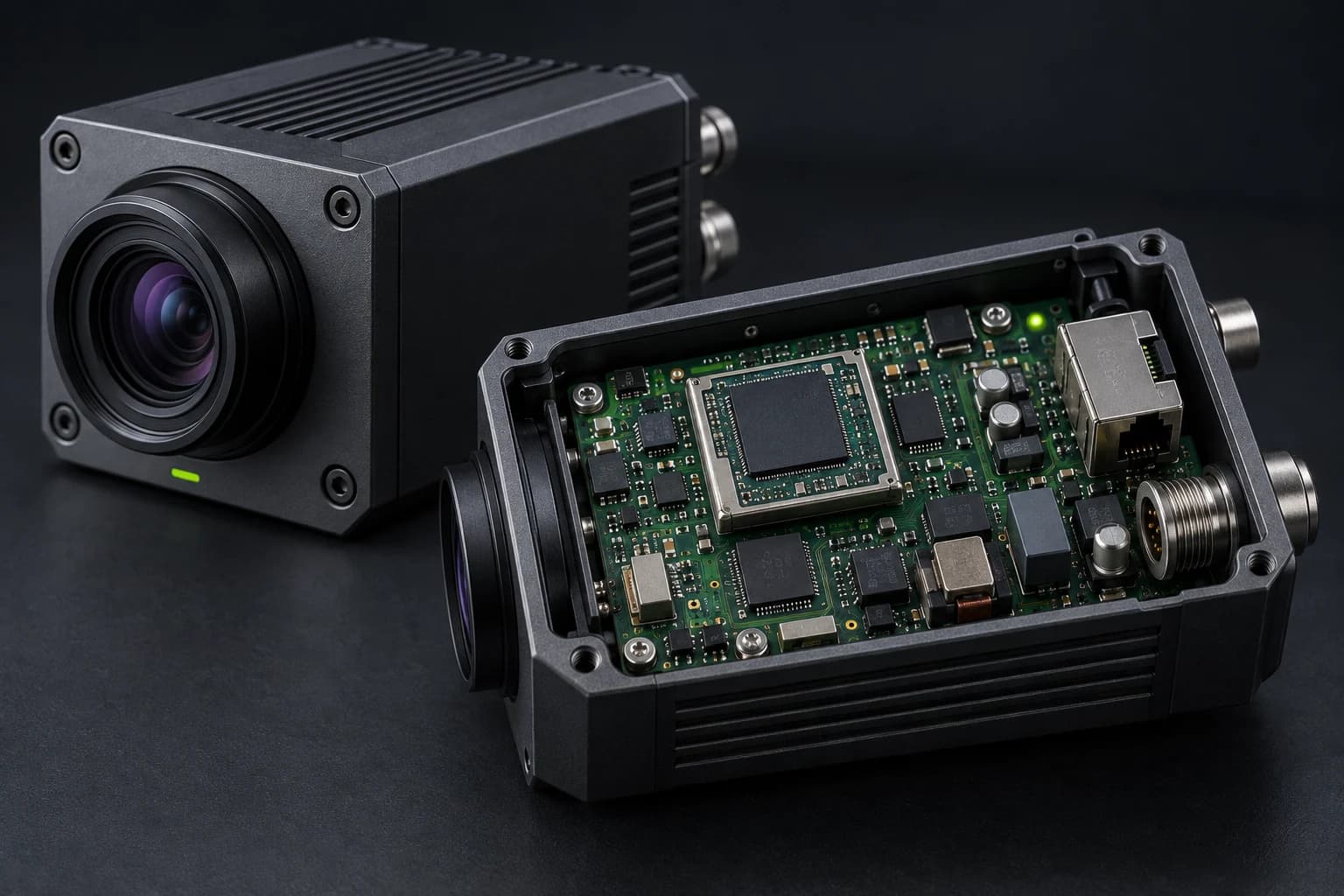 ILLUSTRATIVE CONCEPT / NOT MEASURED HARDWARE
+APPLICATION EVIDENCE
A clear path from
sample to specification.
Hardware images are earlier concept visualizations, not current released configurations. For a concrete installation, start with sample images, working distance, field of view and the machine interface.
Agree acceptance criteria, operating conditions and required compliance documentation in the project scope. Demonstrations explain the method; application tests establish the result.
+Practical questions
A little more clarity.
Why a modular sensor board?
Separating the image sensor from the carrier can support different imaging choices while retaining a common compute and I/O foundation. Signal integrity, mechanics, and thermal behavior still need validation.
Are RGB and monochrome interchangeable?
RGB and native monochrome are separate intended imaging variants. Sensor, optics and illumination need to be selected for the application; a converted colour image is not a native monochrome sensor.
Is the platform open source?
No open-source commitment or licensing model has been announced. The current focus is defining practical hardware and software requirements with potential users.
+OPEN FOR APPLICATION EVALUATION
Have a constraint we should design for?
Machine builders and integrators: tell us about the connector, the mounting space, the cycle, or the interface that matters.
Discuss your application